📑 education.md
When and where?
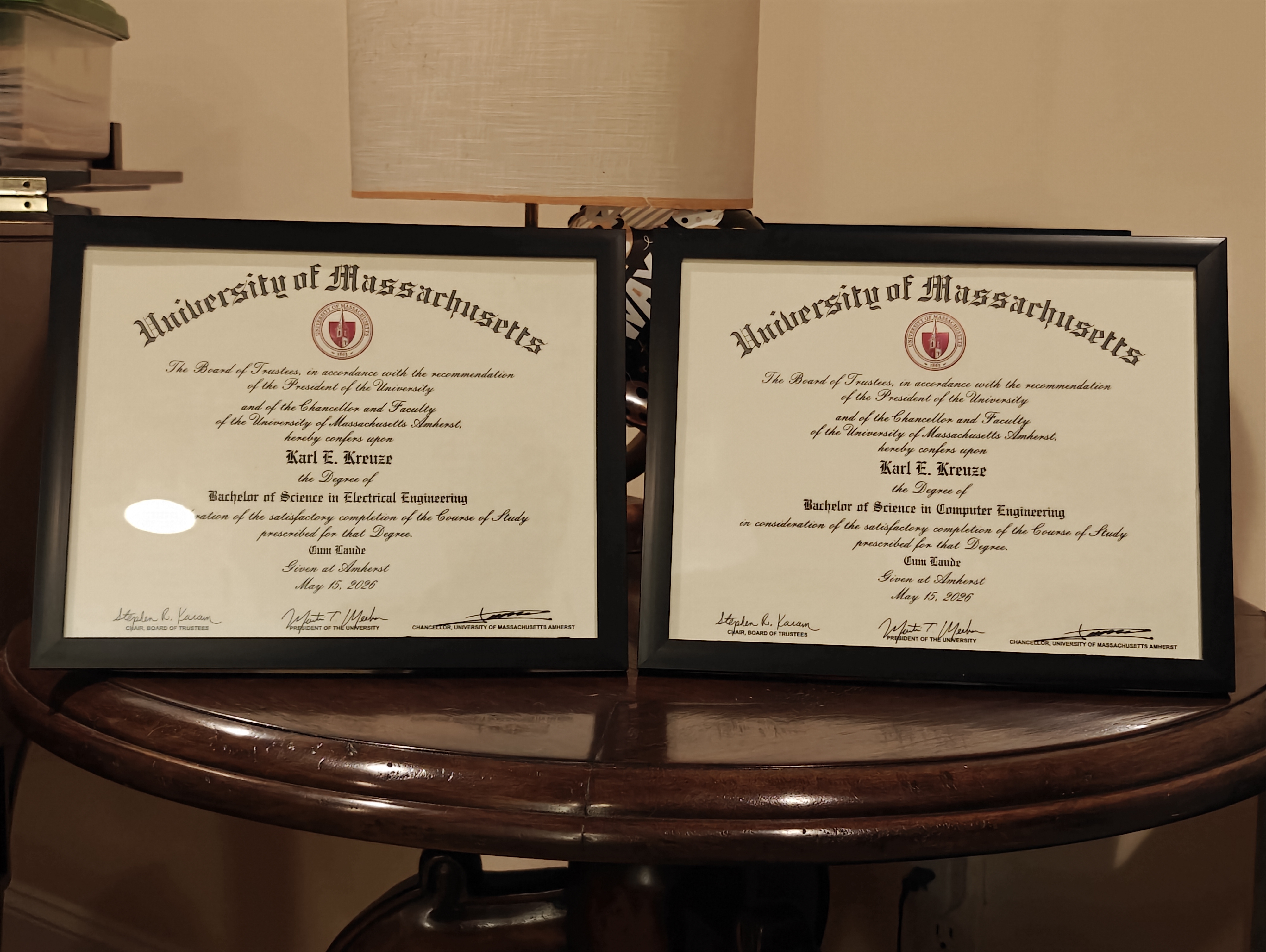
I began classes at UMass Amherst in September 2022, with a declared major in Computer Engineering. I intended to dual major in both Computer Engineering and Electrical Engineering, so my undergraduate advisor helped me out in planning my educational career for that. I had so many credits from high school that later on, my academic advisor actually suggested that I go for dual degree rather than dual major. I took on the challenge, and got approval from the my undergraduate advisor in my senior year to get two degrees, and on May 16th, 2026, I graduated Cum Laude with my B.S. in both Computer and Electrical Engineering. I carried two medals and two tassels at the Mullins Center. I am now enrolled in the 4+1 accelerated master's program at UMass Amherst, expected to finish in May 2027.
Course history
I like to think that I've seen about every nook and cranny in the ECE curriculum, so I figured I'd compile a table to document my experience. This may be useful for any incoming engineers that want my opinion on a class before finally enrolling.
Material TL;DR
The notable topics I have gotten comfortable with during my time at UMass Amherst include, in no particular order:
- Semiconductor devices
- Digital signal processing
- Microwave engineering
- Analog circuits
- Algorithm verification
- Quantum computing
- Operating systems
- Machine learning
- Cybersecurity
- Computer architecture
- Computational tools (MATLAB, Excel)
Of course, refer to below table for topic keywords and the rigor of the class.
Back to the details
I ended up with 154 credits, although 23 of these were test credit.
When I rate courses, I will rate them in chronological order from best to worst. For example, I give PHYSICS 152 a 1, and ECE 311 a 40, to create a sort of tier list in lieu of a more subjective scale such as star ratings, etc. Of course, some of these are required for the major, so the ratings will sound as if I am helping a non-major pick ECE classes for whatever reason. The rating will be most heavily influenced by the importance of the material, how much I personally enjoyed the material, how well it was taught, and the workload.
| Course | Title | When | Who | Rating | Grade received | Comment |
|---|---|---|---|---|---|---|
| ART-HIST 100 | Ancient-Medieval Art | Fall 2022 | Laetitia La Follette | 35 | A | Easy AT/DG gen-ed. No complaints. You learn about some of the important eras of art and specific works of art, and then write a few papers, and take a few easy exams. The course content was recorded and asynchronous. |
| E&C-ENG 202 | Computational Tools for ECE | Fall 2022 | Bill Leonard | 27 | B | Important class for future employment. Teaches you MATLAB and Excel. I totally could've gotten a better grade by reaching out to the professor for additional submissions at the end of the semester, but at the time I didn't know that the professor is very accomodating. The mastery system of grading doesn't really work for my brain. |
| ENGIN 112 | Intro Electrical & Comp Engin | Fall 2022 | Tilman Wolf, C.V. Hollot, Paul Siqueira | 28 | A- | A little disorganized due to the range of topics covered. The rigor was also really odd, since it would cover oversimplified topics that you would later study in the ECE curriculum. I got really ill during the final and had to take it on Zoom. Teaches some odds and ends about signal processing, differential equations, etc. |
| FYS 191ENG20 | FYS-Intro / SustainbleEngineerng | Fall 2022 | Lohita Rajesh | 36 | A | One graded presentation at the end of semester. Lecutres talked about ways engineering is innovating to be more sustainable. |
| MATH 233 | Multivariate Calculus | Fall 2022 | Jie Min | 21 | A | The rating is heavily skewed for myself. At the time, I really enjoyed studying calculus, and was lucky to have the best of the instructors at the time. I heard horror stories from my friends in other sections. My section consistently outperformed the others... Teaches you calculus in several dimensions, alongside some parametric stuff, optimizations, etc. |
| MATH 235 | Intro Linear Algebra | Fall 2022 | Daniel Gallagher | 18 | B+ | I really regret not giving this class more effort. I learned later on in the engineering curriculum how important this subject is. At the time, I found this class very abstract and not full of purpose. The instructor was great. Teaches you about matrices, eigenvalues, and some simple basis and transform stuff. |
| E&C-ENG 124 | Intro/Digital and Computer Sys | Spring 2023 | Yeonsik Noh | 39 | B | Easy homeworks, but the exams were unfair and I don't believe they were curved. I was comfortable with the exam material, but still ended up being very rushed during exams due to the questions being very involved, and the exam time being very short. I heard from students after myself that the class is a lot better now. Teaches you about logic and numbers in different bases, as well as some stuff about flip-flops and adders. |
| MATH 331 | Ord Dif Eq/Sci Eng | Spring 2023 | Aubain Hilaire Nzokem | 33 | A | I went to syllabus day, and then realized I don't have the energy for 9AM classes, and proceeded to skip every single one after the first, and I had one of the highest exam averages in the class. I personally found that the online homeworks were actually very helpful to learning, and I think that is why I did so well. Teaches you numerical and analytical methods for solving differential equations, and had some matrix stuff thrown in. |
| PHYSICS 152 | General Physics II | Spring 2023 | Paul Bourgeois, Nicholas Pittman | 1 | A | Special shoutout to Nicholas. He is a graduate student and I believe he has a distinguished teaching award, and for good reason. I've genuinely never experienced a course instructor care for students so much. Teaches the fundamental physics of EE, such as fields and circuits. |
| SRVCLRNG 293 | Learning Through Comm Engmnt | Spring 2023 | Stephen Fernandez | 17 | A | Easy SB/DU gen-ed. The class was engaging, and the the professor is awesome. Talks about societal impacts of engineering such as bias in machine learning, as an example. |
| E&C-ENG 241 | Advanced Programming | Summer 2023 | Eric Polizzi | 24 | A | First time taking an asynchronous class. I already knew all the content from my experience programming in C prior. Recorded lectures were the course content, and the exams required you to record yourself taking it through Moodle. I thought it was very easy, but the exam averages indicated to me that some peoeple were struggling (or maybe were busy with other summer commitments?) Teaches you about linked lists, search algorithms, etc. |
| ANTHRO 150 | Ancient Civilizations | Fall 2023 | Johanna Pacyga | 32 | A | Easy HS gen-ed. I dozed off in lectures, and then resorted to Google to pass the online weekly quizzes, since students were allowed to use search engines for the quizzes due to them supposedly giving students wrong answers. I think I aced every quiz. Better yet, the final was just a culmination of those exact same quiz questions, so I left the final in ten minutes, and aced it. Discussions required some particpation, but the TA made it easy. Teaches you about where human civilization came from and how to analyze human remains and such. |
| COMPSCI 250 | Introduction To Computation | Fall 2023 | David Barrington, Ghazaleh Parvini | 22 | A- | This infamous class was advertised as the hardest class in the major, so I enrolled with a close friend of mine to dial in, and... It wasn't too bad. The lecturer blitzed through the course material, and the TA during discussion didn't really help with going over the lecture content. Homeworks were certainly a time commitment, but definitely possible, and definitely helpful. Exams were very tough. Teaches you about mathematical proof. |
| E&C-ENG 210 | Circuits and Electronics I | Fall 2023 | Jun Yao, Robert Niffenegger | 38 | A- | Another 9AM that I couldn't bring myself to go to. From syllabus day, Jun Yao seemed pretty funny, but I didn't see much of him. Homeworks and labs were really easy, and I aced all of them... Until I didn't. Mysteriously at the end of the semester, a bunch of my homework and lab grades were changed from almost full score to single-digit. I emailed the professor and the TA, and they said they would look into it, but they never did. At least no weird stuff happened with my exam grades, and I performed really well on those. The class teaches you about KCL and KVL, and then some time-domain stuff with passive components. |
| E&C-ENG 296C | IS-Complex Numbers | Fall 2023 | Bill Leonard | 34 | A | Fully asynchronous, online textbook, no lectures, ten easy quizzes (mastery system) and one MATLAB assignment. Teaches you about complex number operations. Enough said. I wish there was an archive of the Moodle announcements, but I remember the professor stating that by the time grades were due, only about 9% of the class actually completed all the assignments. As a result, he extended the due dates all the way out until the next semester. I only started the course assignments that winter... Oops! |
| E&C-ENG 322 | Systems Programming | Fall 2023 | David Irwin | 15 | A | This class teaches you about Linux and some C programming. I found it absurdly easy, given my prior experience. Homeworks were code that you write in a VM with Ubuntu on it. Exams were free-response questions that look at the big picture of Linux and program structure. |
| E&C-ENG 331 | HardwareOrganizn & Digi Design | Fall 2023 | Yadi Eslami | 30 | A | I went to the first class, found the content to be paced really unusually slow for such a high level course, and proceeded to skip every class and do the homeworks on my own with the help of the textbook. The homeworks were quite easy, and the exams were a bit difficult compared to the homeworks. By my standards, I didn't do to well on the exams, but I was still well ahead of the curve thankfully. I think this was the first class where I was exposed to exam averages in the 40s. It taught you the basics of the CPU pipeline and the topics of caching, branch prediction, etc. |
| E&C-ENG 213 | Continuous-TimeSignals&Systems | Spring 2024 | Do-Hoon Kwon | 37 | A | This class was unexpectly infamous in my friend group. I actually went to every lecture... to do the homework. The professor had incredible handwriting, but the content was provided as if the professor were just copying from the textbook. Despite these setbacks, I found the class material really easy, and knocked the exams out of the park. The curve was absurd, with a B- placed at around a 50%. The class teaches you about continuous time convolution, fourier transforms, fourier series, etc. |
| E&C-ENG 214 | Probability and Statistics | Spring 2024 | Dennis Goeckel | 12 | A | This class teaches you about expectation, variance, properties of probabilities, cdf, pdf, etc. Exams were easy and the homeworks were easier. Our class mysteriously was outperforming the professor's previous sections of the class by like ten points, so there were probably a lot of people cheating. The professor's teaching was really good, and his delivery of course material was sometimes so catchy, that on an exam I would wonder what to do for the problem, only for the voice of the professor to appear in my head, and tell me how to start the problem. |
| E&C-ENG 231 | Intro/Embedded Systems | Spring 2024 | David McLaughlin, Fatima Anwar | 19 | A | This may be an example of a class that might've been a little too easy. It started by teaching about embedded Linux, and then ended with teaching about Arduino. A lot of people got good grades in this class by just copy pasting code that was on the lecture slides to their lab assignments, which was about 90% of the work that was needed. As a result, a lot of students didn't get the appropriate rigor to fully understand the convenience of Arduinos in rapid circuit prototyping. The exams were open-note, extrordinarily easy, and online. I didn't go to class, and thusly spent maybe four hours total on the entire course. |
| E&C-ENG 244 | Modern Physics & Materials/EE | Spring 2024 | Neal Anderson | 8 | A | The course covered topics that weren't fully talked about from PHYSICS 152 and then transistioned into quantum physics and semiconductor physics. I fell in love with these topics. The homeworks were really challenging, and were productive for me since I'd need to spend a lot of time browsing Wikipedia to figure out how to solve it, and end up learning about other cool things. Although, I will say, the homeworks were definitely a little too hard, and some people just opted to not do them because of that. They weren't worth much of your grade anyway. The exams were ridiculously easy though, especially if you did the homeworks. The professor is also really friendly, and somehow knew my name even though I don't remember ever talking to him face-to-face by the time I realized he could connect my face to my name. I was at the campus center getting lunch when he called out to me, and I was pleasantly taken aback. |
| E&C-ENG 303 | ECE Junior Seminar | Fall 2024 | Neal Anderson | 25 | A | This is the class that tells you to not work at Lockheed Martin. Guest lecturers come in and talk about ethics in the first half, and then in the second half, guest professors come in and talk about their research, to give you an idea of where to go after college. Two graded papers, and some short 2-3 sentence reflections after classes were the only graded components. Very easy. |
| E&C-ENG 310 | Circuits and Electronics II | Fall 2024 | Robert Jackson Jr | 23 | A- | This class covers the basics of power electronics, small signal models, and some MOSFET amplifier stuff. There were five exams, and none of them were curved, and the professor was known for never giving partial credit on exams. No graded homeworks. It's really unfortunate, because the professor taught well, but the exams just made the class so much worse. At least the labs were graded nicely and they were easy. I blew up capacitors in the lab while waiting for the TAs to come check my work, lol. |
| E&C-ENG 315 | Signal Processing Methods | Fall 2024 | Dennis Goeckel | 14 | A | This class teaches you about autocorrelation, discrete-time convolution, filters, etc. The professor is great at teaching the material. Because of the professor's teaching, the homeworks and exams were very easy, apart from a challenging extra-credit problem on each exam. The class averages were pretty low which surprised me, but I do suppose at this point in the curriculum the content is pretty unique, so not everything is going to be so trivial. |
| E&C-ENG 333 | Fields And Waves I | Fall 2024 | Stephen Frasier | 11 | A | I really liked the professor's personality. However, his voice and tones were a little... too relaxing, and I would have a hard time paying attention, since I'd easily get distracted with something else, and his voice wouldn't snap me back to reality. Additionally, he got busy with a lot of lab work and ended up quite a bit behind the material needed to cover the homeworks, so some textbook reading was in order. The content was totally manageable, the homeworks were appropriately challenging, and the exams were a lot easier compared to the homeworks. This class teaches you transmission line theory, and some electromagnetic field theory. |
| E&C-ENG 371 | Intro/Security Engineering | Fall 2024 | Taqi Raza | 29 | A | Very, very odd class, probably because it was the professor's first time teaching it. Also, I think the department didn't help the professor at all by trying to cram content from another class into this one. The lecture content indeed covered cybersecurity, but the labs covered FPGAs and the homeworks covered... Excel? This class is required by the computer engineering major, but I think the class content tries to cram both cybersecurity and FPGAs into a required computer engineering class. The FPGA component really should be its own required class, since I do think the content is important and innovative. Despite the oddness, the first exam was very difficult, followed by a final that was very easy. Honestly, the final exam questions were so open-ended and non-specific that I think someone in IT or otherwise aquainted with computers would do well. The labs were also easy, but sadly didn't do the FPGAs justice. We simply used them to run Linux, to program algorithms such as RSA encryption on them. Oh well, the class was pretty easy overall I'd say. |
| ENGIN 351 | Writing in Engineering | Fall 2024 | Jacob Dyer-Spiegel | 2 | A | This class teaches you how to get a job, among other things. You learn how to write a resume, and also how to write documentation/research. The professor was incredible, and very, very accomodating. He's not even an engineer, since he's from the Isenberg school, but he clearly had a deep understanding of the average engineer's life. As a result, deadlines were pretty soft, and if you were very late on an assignment, he'd extend deadlines for you, and gently prod you to complete them. Also, sometimes in class he wouldn't have much to cover, and either have it outside when the weather was nice, or simply sit at the desk and dismiss those who don't need any help. |
| E&C-ENG 304 | Junior Design Project | Spring 2025 | David McLaughlin, Baird Soules | 7 | A | Pretty fun class that teaches you how to design a PCB. I didn't go to any of the lectures since I had to hold office hours for a class I was a TA for at the time, but Baird was okay with that, and respectfully poked fun at me in front of the class when I wasn't there (lol). You designed a PCB that used an ATTiny to read the voltage on a thermistor, and display the temperature on an SSD1306 OLED, and the course coordinators actually made an order of everyone's PCBs to solder up and demonstrate. This class got me really interested in homemade PCB fabrication. |
| E&C-ENG 311 | Intermediate Electronics | Spring 2025 | Robert Jackson Jr | 40 | B | Similar to the other class this professor teaches, there are a lot of exams, and basically no partial credit. The class covered differential amplifiers, BJTs, and circuit noise. I did good on exams up until noise, and then the professor's lectures became really hard to follow. One of my close friends got a three on an exam, despite showing work and coming to an answer with correct units on every problem. I also had another friend notorious for being that one kid that always gets the 100 on the exam, but he was in for a great humbling on that final exam. Did I mention that there were six exams? At least there was also no graded homework here, and the labs were easy and graded generously. |
| E&C-ENG 522 | Modeling&Verif/EmbeddedSystems | Spring 2025 | Daniel Holcomb | 13 | A | When I signed up for this class, I mostly just signed up for the professor, since the topic seemed kinda ultra-specific to me. The content was fufilling, however. It teaches you about algorithm provability with empirical methods such as SAT solving, and also covered time-evolving systems. Exams were very easy, the averages were high, but the labs were no joke. They were nice and rigorous, but the first lab expected you to write a Verilog parser from scratch, which was pretty hardcore. |
| E&C-ENG 550 | Intro to Quantum Computing | Spring 2025 | Robert Niffenegger | 3 | A | I thought this class was perfect. The class teaches you the quantum physics that we use to create single-qubit systems, and then transitions into multi-qubit logic operations, and some algorithms. The homeworks were rigorous, taught me a lot, and you are rewarded with very easy exams. I think the class exam averages were close to 100. Professor is very chill, and funny at times. I represented our class in the Yale YQuantum hackathon in 2025 and actually won our track prize. |
| E&C-ENG 570 | Operating Systems | Spring 2025 | David Irwin | 10 | A | This class was horrifying to me at first, but ended up being okay at the end. The labs are very hard, and they are autograded, but you get a lot of submissions. It was really frustrating having to keep changing the code and being absolutely sure that it works for every hidden test case. I maybe sent 15 submissions per assignment, and only aced them by the very end. The last lab was really fun, since the professor gave you a VM with a bunch of programs that you try to break with shell injection. The first exam caught me really off-guard, and I was humbled, but I did really well on the final, exceeding the curve by a huge margin and ended up getting a good grade in the class. Teaches you about task scheduling, page tables, permissions, etc. |
| E&C-ENG 601 | Machine Learning for Engineers | Spring 2025 | Hossein Pishro-Nik | 9 | A | I think when the class number begins with a six, the professor just assumes that you have the interest in the subject, and trusts you with an easy class to go learn stuff on your own. There were no exams. I think just showing up to one weekly class got you 40% of your grade, and then the rest of the grade were a few lab assignments. However, those labs were Python programs that were about 90% complete already, and you would simply need to add a line or two to complete it. The cherry on top, is that the assistant professor would come into that weekly class for a few minutes at the start, and go through his solutions to the homework before it is due, and you can copy it verbatim, and get full credit. So if you really want to, you can get a 100 in this class, and learn nothing. However, I found the content very interesting and did actually look into the algorithms discussed in detail on Wikipedia in my free time. It teaches you the basics of machine learning algorithms like gradient descent, and then shows you how you can use that to build regression, and then finally how to use that to build neural networks. Then, you learn all the different kinds of neural networks, and I thnk the final lab had you create a basic GPT chatbot, which was pretty cool. |
| E&C-ENG 344 | FundamentalsSemiconductDevices | Fall 2025 | Guangyu Xu | 16 | A- | I skipped the lectures, read the textbook which was very well written, and managed to ace all the hard homeworks, while my friends who went to class really struggled. The course covers the fundamentals like doping and carrier concentrations, then goes over the physics of diodes and MOSFETS. Very cool material, and the exams were a lot easier than the homeworks. I have a feeling that the professor might've been lazy with the grading, since people I knew who did better than me on exams also got an A-, and people who got points less than I did also got an A-. The professor is also really hard to reach outside of class, since he drives in from Boston only on Tuesdays and Thursdays. Wouldn't have been too big of an issue, but he was also my design project evaluator. |
| E&C-ENG 415 | Senior Design Proj I | Fall 2025 | Baird Soules, Wouter Schievink, Jeremy Gummeson | 5 | A- | Not really a class, since it doesn't teach you anything. I designed a hybrid go-kart which has documentation on my website, and the course coordinators loved the idea, but our assigned evaluators did not. Shoutout to our advisor though who did not see our idea as absurd, and totally thought we would finish on time. (We didn't come close.) You have to maintain a GitHub repo with documentation for the project, and otherwise you get graded on two presentations throughout the semester. |
| E&C-ENG 565 | Digital Signal Proc & Rep | Fall 2025 | Weibo Gong | 20 | A | My description of this class will probably be a bit hard to follow, so try your best. I didn't go to class to learn, but to be entertained. At least, I tried to learn, but ended up listening to a professor with a really funny sense of humor, and a thick Chinese accent procrastinate teaching the course material. He would always go off about random things in engineering, and crack a lot of jokes, and was very funny overall, but as the semester went on, we ended up further and further behind on material. This class was supposed to get to Hilbert Spaces, but we never did. At least we got a pretty good understanding of DFT, filter design, image processing, and linear algebra error minimization with some neat basis transforms. No graded homeworks, but some quizzes to test if you were actually doing them that were for some reason, way harder than the exams. When we were nearing the final, the professor hinted that he would reveal a question on the final, but only in class, to keep the participation high. Then, he said he would cover three of the questions on the final, and then finally the day before, he emailed everyone all the questions to the final, probably because he realized we were really behind. Indeed, I showed up to the final, knew how to do every question because I specifically studied the questions he emailed us, and never knew how I did on the final, but I got an A overall. |
| E&C-ENG 584 | Microwave Engr I | Fall 2025 | Stephen Frasier | 6 | B+ | Course material covered waveguides, transmission lines, wave propogation, and resonators. The material was actually really cool, but the professor was a little too relaxed, and it was hard to follow, since his lectures were like a soft lullaby to my ears. The labs are the most rigorous part of the class, and you get to play with instruments that are similar in price to a Porsche GT3RS. I completely whiffed the second exam, but that's totally my fault, since all the exams were easy. |
| E&C-ENG 416 | Senior Design Proj II | Spring 2026 | Baird Soules, Wouter Schievink, Jeremy Gummeson | 4 | A | We didn't build the go-kart in time for demo day, but we completed our two presentations to the best of our ability, and demonstrated our hybrid powertrain on demo day by revving it out like crazy outside the hall where all the other projects were. |
| MICROBIO 140P | Plagues, Poxes, and Pandemics | Spring 2026 | Stephen Rich | 31 | A | Very, very easy biology gen-ed. A few ai-graded question and answer weekly assignments that you can turn your brain off for, and weekly quizzes that you can google the answers for. Teaches you about the different forms of disease, and how they came to be. |
| MUSIC 100 | Appreciation-Intro | Spring 2026 | Benjamin Court | 26 | A | Very easy AT gen-ed. You show up to class, go to a concert and write about it, and interview a music hobbyist, and get an A. You learn music theory as well as music culture. |